Saturday, January 31, 2015

Our Happy Human Family

From the various social reform movements we learned, it seemed reasonable for our class to touch upon the women's reform that took place in the mid-19th century. 
     Gender equality has been an ongoing problem in society for as long as we can remember. Sadly, it has almost become part of human nature to put men ahead of women, and give them more of an advantage than their opposite gender. Several actions have been taken to avoid this problem of gender equality. Our class focused on problems that took place during the 1800s.
We can learn the legal laws that refrained women in society by observing The Rights of Women: Laws and Practices, published in 1848. The document states that women were not allowed to speak in public, not allowed to own their own property, not allowed to vote, and were paid 30-50% less for teacher jobs, let alone provided education in schools. It was also legal for men to beat their wives and take children away from their mothers during a custody.
     A certain movement we can look at that aimed to support women's rights took place around the middle of the 1800s. The role of women in the movement to abolish slavery was quite significant. It was through this reform, women realized that they too deserve rights similar to the African Americans. The Seneca Falls Convention of 1848 was an abolitionist movement that took place in New York. It was during this convention that women got together and extended the abolitionist towards themselves, demanding the right to vote publicly. This demand for new rights stirred several reactions, some being positive while others being completely against it.
An excerpt of the article published in the Mechanics
Advocate, displaying their disapproval for the demands
 of women's rights

     Many of the reactions of the mid-19th century society deemed that demands for gender equality was something morally wrong. The convention immediately became public and voices for and against the movement were spread through papers. The Female Department from the Mechanics Advocate strongly showed their disapproval for the movement by publishing the article Women Out of Their Latitude. This article used a specific example to support their argument. By mentioning the story of Adam and Eve and the events that took place then (image on left), the article shows that it would completely absurd to have women be viewed equal to men. The article shuts down the idea of equality for women.


While many preferred that women stick to their traditional duties, some respected the idea. Such arguments that supported the women's reform movement, added more heat to the debate. The North Star was an abolitionist newspaper that published The Rights of Women, which advocated for the claims. We can observe this support from an excerpt (image on right). The article believes that by being an abolitionist newspaper that supports "human freedom", they should also stand up for women. The article seems to agree with the logic of the convention, all humans, including African Americans, Native Americans, and women, should have equal rights. The mentioned "human family" refers to all races, ethnicities, and genders. The article drives home the point of this "human family" to live in harmony with each other while having equal opportunities.

     During this lesson, my class learned to observe these inequalities in the mid-19th century society. After learning many situations that disrespected women in the 1800s, my class was asked to think about the 21st century.  Our history teacher shared with us a commercial that depicted the different stereotypes placed against men and women performing the same action. The 1-minute clip (below) shows what an impact gender can make in today's society.
I personally believe that our world is very far from perfection, and several countries today struggle to provide equal treatment to both men and women. In some countries and nations these differences impact many lives, while in other places they seem to be quite subdued. While the physical differences do remain between the two genders, I believe that everyone should be given the same equal opportunity. Sadly, our world doesn't have the same perceptions. Opinions vary, and many women are scared to take actions because of the consequences they might face. Yet they are a few who stand up for the apparently "less significant" gender, becoming role models to influence the following generations to support gender equality.


Citations:
The Rights of Women: Laws and Practices. Seneca Falls. 1848.
Tanner, John. Female Department- Women Out of Their Latitude. The Mechanics Advocate. American Treasures of the Library of Congress. http://www.loc.gov/exhibits/treasures/trr040.html 
The Rights of Women. The North Star. American Treasures of the Library of Congress. http://www.loc.gov/exhibits/treasures/trr040.html 


Monday, January 12, 2015

A Pledge for Happiness


After learning about protecting nations and growing democracy, my history class began learning about the social reforms that took place in the 19th-century. The protestant revival, education reform, prison reform, women's reform, and temperance movement, are all examples of reforms that arose from observed social problems. This blog post focuses on a primary source related to the temperance movement that took place in the mid-1800s.
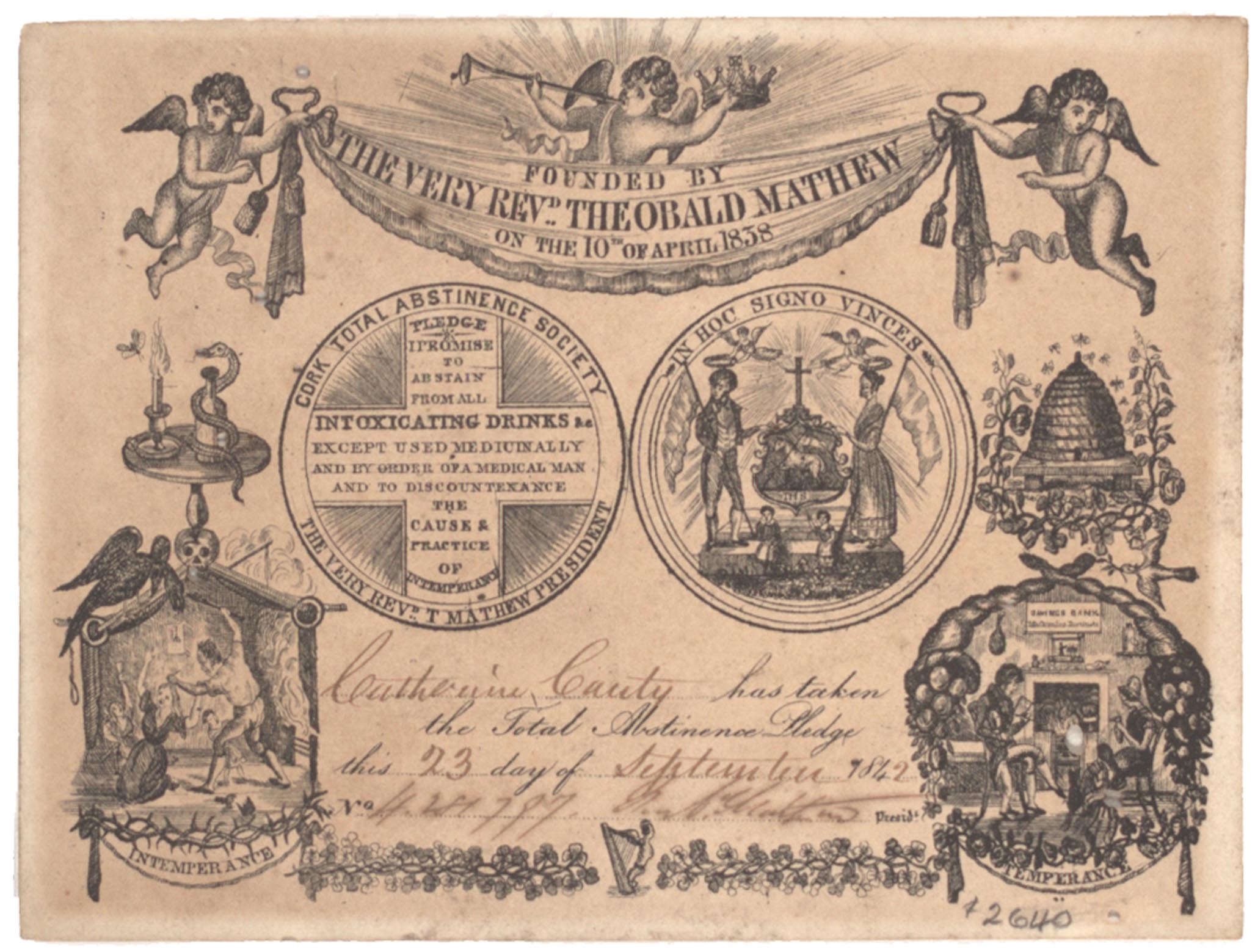
Abstinence Pledge Card by Matthew Theobald
"Theobald, Matthew. "Abstinence Pledge Card." 1842. Accessed January 12, 2015. http://www.gilderlehrman.org/sites/default/files/content-images/02542.27.jpg. "

     Above is an abstinence pledge card, a primary source, that supported the temperance movement that took place from the 1830s to late 19th century. The temperance movement influenced men to drink alcohol in moderation or pledge to total abstinence.
A Catholic priest in Dublin, Ireland, named Matthew Theobald, founded the Cork Total Abstinence Society in April 1838. Several men joined Theobald by signing in his abstinence book and promising to stay away from alcohol completely. Within three months of starting the society, more than 25,000 members had joined, and two months later the number jumped to 130,000. Theobald then traveled across Ireland and internationally, to Scotland and England in 1842, to convince more men to pledge abstinence and stop drinking. He also traveled to the United States in 1849 to spread awareness. By 1851, Theobald convinced as many as seven million people to pledge to total abstinence from alcohol.
In 1842, Father Matthew introduced this pledge card, signed by Theobald as president of the society. The pledge states: "I promise to abstain from all intoxicating drinks, except used medicinally and by order of a medical man, and to discountenance the cause and practice of intemperance." The card depicts a scene warning many the dangers of intemperance, such as domestic violence. Another image depicts a scene of temperance- the act leading to a happy family gathered, say, around the fireplace. This pledge card was signed by Catherine Cauty after four years of the society's founding, in September 1842, showing us that the society was still well-maintained after a long period of time.
This primary source shows us, and the members of the Abstinence Society, the benefits of staying away from drinking. The scenes depicted on the card, such as domestic violence due to intemperance, and a happy family due to abstinence, allow us to see the heavy impact drinking had on society. By analyzing the high number of members in the Abstinence Society, it is easy to see how many people had both personal and social conflicts that were caused by their bad drinking habits. However, Theobald traveled to world to teach the disadvantages of drinking and how the act of  self-control can lead to a life free of stress and conflict.

Thursday, December 11, 2014

Ms. Frizzle Taking It Way Back

With our teacher out of town, our class was left on our own to move forward with the unit of "Protecting a Nation". This week we focused on Andrew Jackson and his impact in the United States.

     Andrew Jackson was America's seventh president, his term lasting from 1829 to 1837. Other than showing up on the twenty dollar bill, Jackson influenced America quite a bit. He was often known as the "people's president"; however it was up to our class to decide if he actually deserved this title. Jackson had his own opinions and usually asserted them into place. He didn't support the power of the bank, had no concern for the Native Americans, and reintroduced the spoils system. From analyzing these three situations Jackson was involved in, we were able to deduce Jackson's true nature.
The bank war was basically a large conflict between the rich stockholders, who had an advantage at the bank, and the middle class and lower, who didn't have much power and was supported by Jackson. Jackson didn't approve of the concentration of the rich power in the banks- his choice angered the rich, and assumed Jackson was a monarch who didn't want anything good for his country. Due to his power, Jackson was able to shut down the Second Bank of America.
Jackson's involvement in Indian removal changed his reputation, as well. Jackson forced Native Americans to leave their home land and head out west. Jackson made himself look good by promising similar rights and resources the Natives had in the East. He showed no concern for the Indians and wished to get rid of them.
The Spoils System was reintroduced by Jackson, overriding the original merit system. Qualification for government jobs was not based on merit but on loyalty. The system works when a president, or someone who is trying to gain votes from people, promises job positions in the government if they vote for them as an incentive. Many accused the use of this system as a way of firing all government officials. Jackson tended to give positions to many, but a few took advantage of the job- in one case where someone stole huge amounts of money.
Our class was split into six groups, and the three topics were divided evenly amongst the class. We were given documents based on our situation and were instructed to create any sort of presentation to share the information with the whole class. My group was assigned to learn about the Bank War, and then create a skit. Our skit was magic school bus theme. So this required Ms. Frizzle to go back in time on the magic school bus to the 1830s to enlighten our class about the Bank War. The link of our script is below, and don't forget to play the theme song while reading!

https://docs.google.com/document/d/1-0MpLOpT0jjLh_sWXNdxCM9V9OIf2P5SI_GYgx16DpY/edit?usp=sharing

Wednesday, December 3, 2014

How Democratic Was US's Democracy?

Currently in the eminent class of Honors History 10, we have been learning about democracy and its impact on the United States in the early 1800s. 
     In order to find how democratic the United States was at the time, my group and I started by defining the term democracy, itself. We then analyzed two primary sources, quotes by Benjamin Franklin and Norton Townshend, and a source on the Dorr War; from this we deduced the situation of the US. Other secondary sources were used, as well- two data voting charts and the County Election painting by George Caleb Bingham. The information collected from these sources were connected to answer the main concept of democracy in US during the early 1800s. My group and I then put together a glog, an online poster, using glogster, to display our analysis and conclusion.

Sunday, November 23, 2014

The Journey of a Successful Leader

http://upload.wikimedia.org/wikipedia/commons/3/32/
G%C3%A9n%C3%A9ral_Toussaint_Louverture.jpg
Leaders are necessary everywhere in society; we have political leaders, social leaders, economic leaders, community leaders, and many more. But there are specific qualities that defines someone a successful leader. There are several traits that are crucial and some that are irrelevant but could aid one’s persona, such as eloquence, compassion, toughness, and humor. These, however, cannot surpass attributes such as political skill, moral leadership, and honesty. It is rare that leaders possess these strong qualities. Toussaint Louverture was born on the western half of the Caribbean island of Hispaniola, Saint Domingue, also known as Haiti. Louverture lived during the time of the Haitian revolt, and as they fought hard for their freedom, he emerged as a leader. Saint Domingue was an economically valuable colony due to its plantations, and ended up in France’s control. The majority of the Haitian population was turned into slaves, and treated harshly. Upon hearing the news of the successful French Revolution, the slaves began their revolts for freedom. It was Louverture who took up the initiative to lead the Haitians to fight for their rights. Toussaint Louverture was a well accomplished person and should be remembered as the liberator of slaves, a military commander, and the ruler of Saint Domingue.
Toussaint Louverture was an exceptional leader for the slaves of Haiti, and should be widely known for this accomplishment. Toussaint took part in the slave revolt in 1791 by serving as a doctor, and commanding a small group of slaves (Doc A). It then took a few years for him to build up his reputation and spread his influence all around Saint Domingue. He strongly advocated for the freedom of all slaves from the French. When the revolutionary government in France under Robespierre abolished slavery in France in all its colonies, Toussaint and his troops stopped their revolt and supported the French, in 1794. (Doc A) When the French Directory replaced the revolutionary government in 1797, Louverture feared for the reinstatement of slavery. In order to respond to this possible act Louverture wrote a letter addressed to the French Directory. In it he evidently doesn’t support the Directory’s decision and tries to dissuade their opinion. He closes his letter with a threat to the Directory, driving his point home: “We have known how to confront danger to our liberty, and we will know how to confront death to preserve it.” (Doc B) Louverture seems devoted and dedicated throughout his letter to the Directory, showing his commitment to freeing the enslaved. Louverture’s successful work as a liberator of slaves led him to assemble and head the commission that created Saint Domingue’s Constitution of 1801. The document proudly declares that “All men are born, live and die free and French.” (Doc C) This statement leads to the conclusion that all men, including the enslaved, are equal and should be given identical rights; the constitution claimed all citizens of Saint Domingue were free. Louverture’s strong ambition for emancipation in Saint Domingue is the reason why he should be remembered as a liberator of slaves.
Along with the role of an abolitionist, Louverture was a notable ruler of Saint Domingue and should be commemorated for his duty. After Louverture defeated the British, he was appointed ruler of Saint Domingue in 1798. In Saint Domingue’s Constitution of 1801, Louverture takes his role as the ruler and authors a constitution that states several rights of the citizens, including rules for the plantation owners, cultivators, and agricultural laws. The constitution promises the abolishment of servitude forever and freedom for everyone. It encourages agricultural work, since the economy of Saint Domingue strongly depends on it. (Doc C) Louverture took the initiative and created articles that satisfy the people and the French government. The citizens of Saint Domingue trusted Louverture, as well- “The Constitution nominate citizen Toussaint-Louverture...the direction thereof for the remainder of his glorious life.” (Doc C) His efforts as a liberator of slaves paid off, and people thought he was credible enough to be their leader. Four months after his nomination, Toussaint authored the Proclamation in November 25, 1801. In this document, he sets harsh punishments for anyone who breaks rules- “Vagabond cultivators arrested...shall be taken to the commander of the quarter, who will have them sent to the gendarmerie [local police]...” (Doc D) This excerpt shows that even the honorable Toussaint can be strict and controlling when it comes to looking after his people. His rule was slightly stern but he remembered to keep his people happy, which is why Toussaint should be remembered as the ruler of Saint Domingue.
However, Louverture’s rule started getting more and more harsh, and he turned into a military commander. Toussaint didn’t rule without resistance from the citizens of Saint Domingue, and he carried his rule to a large extent. Many people, including Louverture’s own nephew, believed that it Toussaint was wrong to support plantation farming. His nephew challenged Toussaint’s policies in agriculture and organized a rebellion. Plantation farming was similar to slavery and the citizens of Saint Domingue didn’t prefer that. His people started to distrust him as well- “...with Toussaint’s draconian [cruel] labor policy and gathering suspicion of his friendliness with the white planter class.” (Doc E) Toussaint’s nephew led a rebellion and Toussaint reacted harshly by having him arrested and executed. By 1802, Louverture was fighting against the French to earn Saint Domingue’s freedom. ‘...Toussaint, by his superior knowledge of the character of his race, his humanity, generosity, and courage, had gained the confidence of all whom he had under his command.” (Doc F) By this point, Louverture was successful as a military commander. He had the true characteristics of a army general and led strong troops to fight the French in Samana. Louverture’s ambitions and hard work resulted to his achievements as a military commander.
Although Toussaint Louverture should be remembered as liberator of slaves, military commander, and ruler of Saint Domingue, he was most successful as a liberator of slaves because he led one of the most efficacious slave revolts in history. It was because of his efforts as an abolitionist, the citizens of Saint Domingue trusted him as their leader. However, his new power corrupted him and his rule turned to a military dictatorship. Louverture was the most successful leading the former slaves to revolt against the French.  Even though he didn't live to see Saint Domingue earn it’s freedom, it was because of Toussaint Louverture’s influence on the former slaves that they fought for their rights and privileges.

Friday, November 21, 2014

We Are Who We Are

This week our class jumped right into the loop of revolutionary revolts in Latin America. Compared to the European revolutions the majority of the Latin American revolutions were based on race, color, and social status, which was disappointing to find out. 

     Racism, unfortunately, is still a problem in society today, and it's appalling to see how the game was different in the 1800s. It is essential to acknowledge human value regardless of race. Back in the early 19th century, almost every conflict caused was due to racial or social differences. The case of a superior class/race gaining control over a less "worthy" class/race was the norm, and was considered right. What wasn't the norm, however, was the thought that everyone who was affected by the consequences of such conflicts had feelings and opinions, too. To see and example of how these situations impacted several races, my history class studied the Latin American revolutions for independence.

We started off by learning the social structure, from the peninsulares, creoles, and mestizos, to the mulattoes, slaves, and Indian people. Our class then split up into three big groups and became experts on one of the following revolutions that took place in Gran Colombia, Brazil, and Mexico. After making timelines and reading about the events that took place, we made smaller groups with experts from all three revolutions and taught each other. Finally, we found commonalities and differences of all the revolutions, along with recognizing the main reason of the revolution- racial and social differences.
     I was assigned to learn all about Gran Colombia, now Ecuador and Venezuela. After reading the documents given, we compiled the following timeline of all the events that took place:

Made using: http://www.readwritethink.org/files/resources/interactives/timeline_2/

Once the timeline of the Gran Colombia revolution was made we shared it with the other two groups. After gaining knowledge of the other two revolutions, we compared and contrasted the motives of the people. All three revolutions took different routes to gain their independence, but they all ended up successfully breaking their connections with rulers from Europe. Once they were free, they went on their separate ways and used different styles of government. However, in all three cases, it is hard to deny that the motive of the rebels was not due to their social standing and racial backgrounds. The revolts were almost always creoles, mestizos, and mulattoes going against and overthrowing the minority of peninsulares from Europe. In some cases, imperial taxes were unnecessary, while in others a new constitution with improved rights was wanted. But racial background were an issue and the main motive behind all three revolutions. 
     Even though human kind has come a long way trying to avoid slippery racial situations, problems still exist. Of course there aren't hundreds of people forming armies and warring their so-called superiors, but the fight for equal rights is quiet and brewing underneath. Many try and cover these racial stereotypes while some can't help but pick up on them and make a humongous deal. There are still several issues that go on in the real world today; take the Ferguson case, for example. Let's not get into further detail, but the point is clear- race has impacted the world and will continue to do so until we do not consider the issue and try and overcome several theories of society. It isn't easy to eradicate future racial situations, but at least we can help by understanding and accepting people for who they are, then possibly this issue could improve for the generations yet to come.

Monday, November 10, 2014

Melancholy Revolts

This week we learned about the revolution uproar that took place in 1830 and 1848 all through Europe. Our history class placed ourselves in the roles of historians and were made to conclude whether these revolution were successes or failures.

Whenever I think of word revolution I think of a bunch of angry people who want bread and money from the snobbish kings, and that's basically what the motive of the many revolutions that took in 1830 and 1848. Many historians have concluded that these social uprisings were failures, however, my class dwelt in deeper and examined each revolution to make our own decision. The revolutions that we focused on was the- Decembrist Revolt, France Revolts of 1830 and 1848, the revolt of the Frankfurt Assembly, and the Hungary revolt. Before we began our mission, we had to create a scale of success and failure, and determine the traits of each category. We were then put into small groups and given a revolution to focus on. We were to create a quiz of about 10-11 questions on our revolution using SurveyMonkey. Then using the survey we were to decide the success/failure of each revolution.
My group was assigned to the 1825 Decembrist Revolt. Using a document with primary sources and basic facts, we began to chart the basics, and then find evidence from the primary source documents to determine position of the revolution on the scale of success. The Decembrist Revolt took place in Russia during the December of 1825. The confusion over the succession of Tsar Alexander I's throne led to the revolt. The people wished for a new constitution and thought that by having Constantine, Alexander's younger brother, on the throne, they would have a better chance of granting it. However, Nicholas I, Alexander's other brother, took over the throne, and refused to give more rights to his people. In fact, Tsar Nicholas I shut down communication with all of Europe, and didn't give any freedom at all. According to Marquis de Astolphe Custine, "...the conduct of the Emperor [Nicholas I] in forbidding his subjects to travel, and in rendering access to his own country difficult to foreigners." Russia became an autocratic nation, and the caste system was strictly enforced. Nicholas I was quite harsh while enforcing these decrees; during his conversation with a French ambassador he says: "The law demands retribution and, in their cases, I will not use my power to grant mercy. I will be unbending; it is my duty to give this lesson to Russia and to Europe." Nicholas I gives the exact opposite of what his people hoped for. It is quite obvious to conclude that the outcome of this revolt was a complete failure, in that the rebels landed in a situation worse than before.
On the other hand, our SurveyMonkey  succeeded and resulted in not too many wrong responses. After analyzing the results of our quiz, we found out that our classmates "fully understood" the topic of the Decembrist Revolution:

After taking the survey on the other revolts, our class was ready to agree with the historians to conclude that all the revolts were on the failure side of the scale. The Decembrist Revolt resulted in the worst outcome compared to the others, with the dictatorship of Tsar Nicholas. While the French Revolutions of 1830 resulted in a constitutional monarchy of Louis-Philippe, it did get de-throne Charles X. The Hungarian Revolution on the other hand did get temporary results by the Austrian government ending serfdom and writing a constitution to protect basic rights; unfortunately, with the help of the Russian troops, the Austrian rebels were crushed, and all was lost. 
The flurry of revolts that took place in 1830 and 1848 were not quite successful, yet it shows us that the people were not happy with their country and wished for change; sadly, reform and change in Europe took a while.