Tuesday, April 7, 2015

Hunting for Knowledge

This week our class observed the various battles that occurred in the East, West, and Naval theaters during the civil war. From these observations, we were able to understand the conclusions of the war.      
Map of major battles of the Civil War
http://media.web.britannica.com/eb-media/55/89955-004-063A0A0A.gif
      Now that our class has learned about the separations that were created due the elections of 1860, we began to observe the tactics of the Confederacy and the Union. The battles of the Civil War took place in three "theaters": in the west, east, and naval. Our goal was to conclude who the ultimate victor, the north or south, was in each of the theaters. To make this decision we went on a scavenger hunt!
Individuals or groups of two were assigned to a specific battle, and we spent a class to research the battle. Basic information such as the location, date, victor, theater, and reasons for the results were all gathered. This information was all put together in a Google doc with an image, and the first step in the hunt was done: creating the virtual stops. I was assigned to the battle of Antietam, that took place in Maryland. Once my online battle stop was created, a QR code and a shareable link to the Google doc was made, and printed out. The next day in class, we collaborated with the battle stops that came before and after, and exchanged the locations of our signs. After placing our battle signs in a place as tricky as possible, our class began the hunt.
The scavenger hunt took a total of two class, and in will admit that I got more of a workout during those periods than I did in my whole gym semester. I enjoyed learning about the battles using the hunt; it was more fun and hands-on than just taking notes. I think by engaging us in activities like this, classes can learn a lot about the subject without falling asleep.
      Once we gathered the basic information of all twenty battles, the victors of each theater were pretty obvious. My class used Padlet to put together everything learned from the hunt and analyze the conclusions.

Majority of my classmates concluded that the Union dominated in the western theater. Taking the advantages of the lack of supplies the Confederates had, in battles such as the Siege of Vicksburg, the Union. During the Chattanooga Campaign, the north created an effective advance that scattered the Confederate troops, and resulting in an ineffective strategy for the south. In both battles the Confederacy surrendered due to a loss of troops. 
It was concluded that the Union also dominated in the naval theater. The north was better prepared both in strategy and resources, causing a large loss of troops in the Confederate army (a situation similar to the one in the western theater). In battles such as the Surrender of Fort Donelson, the Union army received more reinforcements than the Confederates. These large number of troops surrounded the Confederates until they fled or surrendered.
However, when trying to decide which side conquered the eastern theater, our class was stuck. From the information of all the battles, the Union and the Confederacy seemed to have a fair share of victories. After furthering analyzing the dates of each victories, it was easy to observe that the north dominated in the east over time. As the Union learned new strategies and tactics to take on their rivals, the Confederates slowly ran low on supplies and troops. This imbalance allowed the Union to gain control of the once Confederate dominated eastern theater.
     Due to their lack of preparation and loss of troops the Confederates lost their battles, allowing the Union to conquer all three theaters. This lesson's format with the scavenger hunt and the use of padlet allowed me and many of my classmates to better understand the outcomes of the Civil War, and I hope we do more interactive activities in the future.

Thursday, March 19, 2015

Linking Art

This week our class focused on the divisions and separations amongst the country right before the Civil War took place in 1861.

     The buildup of conflict amongst the states eventually led to varying opinions and separations. In order for our class to understand the reason for these divisions, we learned about the Election of 1860. The results of the election were representative of the deep divisions over slavery. The four parties were: Republican represented by Lincoln, Northern Democrat represented by Douglas,
Southern Democrat represented by Breckenridge, and Constitutional Union represented by Bell. All these parties wished to benefit the states they represented. However, Lincoln won the election with majority of the north voting for him.
     To learn more about this topic, our class split into group of two. We then visited an informational site of artwork on the Civil War. Our class was assigned to look further into the story behind the artwork. We had to then connect each topic to the Election. Using these pieces of art that depicted events before and during the war, each group was asked to create a brief documentary. We also had to choose other primary source artwork to fill in the time between the events from the online gallery. Our overall goal from this project was to figure out the results from the Election resulted in the divisions of the country. Below is the almost four minute video:


https://www.educreations.com/lesson/view/civil-war-in-art/30038024/?s=9xMJJj&ref=appemail
Civil War in Art
 Citations:
Civil War in Art. The Art Institute of Chicago, Chicago History Museum.  http://www.civilwarinart.org/exhibits/show/causes/introduction/the-election-of-1860-and-seces
 

Thursday, March 12, 2015

A Guide On How to Win the Civil War

Once learning about the major reasons that led to the Civil War, our class was given several statistics related to the war. From this we were to analyze them and determine how they affected the strategies and success of the Union and Confederacy.
     The United States was entering a time of conflicting decisions and opinions in the mid-19th century. In my previous blog I discussed a few events that led up to the final decision of war. The anti-slavery advocates from the North were known as the Union, and the South fought for slavery as the Confederacy. Our class was given the statistics of the situation in the 1850s-60s. From this each student was assigned to create a pictorial representation, using the website Infogram, and determine how they impacted the outcome of the Civil War. While some points were obvious through the statistics, a few were a little tricky to connect and analyze.

 
     My infogram above holds statistics that I felt was necessary in helping understanding the situations faced by the Union and Confederacy at the start of the war. After analyzing the statistics, it was clear to notice that the North had several more advantages in the war than the South. With their easier modes of transportation, booming industries, and beneficial economy the North was better prepared than the South. A much larger portion of the population lived in the North giving them the advantage of a stronger Union army while allowing a sufficient labor force to remain behind.
The South also had a few advantages while compared with the North. Most of the nation's military colleges were in the South and the majority of trained officers were Southerners. These officers sided with the Confederacy, giving the South a better advantage of military technique and a trained army. The Southern army only needed to maintain a defensive position and keep from being beaten, while the North had to attack and conquer.
     Both the Union and Confederacy used their advantages and resources, and incorporated it in their military strategies. For example, the North shut down the ports so the South couldn't ship cotton, their most important industry, to Europe. The Northerners also prevented the South from importing the manufactured goods they needed. With no income from cotton exports, the South could not earn the money it needed to buy guns and maintain its armies. The Confederacy strategized a war of attrition: a military strategy in which one side inflicts continuous losses on the enemy in order to wear down their strength, then attacking until they surrendered. However, the North had the same strategy in mind and the Confederacy's plan backfired.
Both sides felt that they were fighting to preserve their way of life and believed their right to self government. While the Union for the free rights of slaves, the Confederacy fought to use them for their benefits. I found the infogram assignment interesting. I liked working independently and expressing my knowledge on the Civil War creatively. It also allowed me to analyze the war in a different perspective, enabling me to understand reasons behind the outcomes of one of the most disastrous events in America.
 

Friday, March 6, 2015

The Elephant Named "Slavery"

Still focusing on the topic of slavery, our class spent the week following the events that took place in America during the mid-19th century. 
     Slavery was still an evident problem in the 1850s, with the rifts that were caused between the north and south. While the North advocated against slavery, the South equally fought against it. This debate in American politics was conspicuously caused by slavery. This type of situation in politics is known as an elephant in the room. In this case, the elephant, root issue, of slavery causing problems in society was avoided during this debate. To explore this issue further, our class followed and learned all the major events that took place. After being split into groups of three, we were assigned to create a timeline of the incidents that occurred between the North and South from 1820 to 1860. Our timeline was organized with all the events benefitting the North above the line and the events benefitting the South on the bottom:


Timeline: 1820-1859
     The event that led to several other occurrences relating to slavery to take place was the Compromise of 1850. All was fair in 1820 when the United States was evenly split into eleven free states and eleven slave states. This allowed the slave states and the free states to have an even number of votes in senate. However, the States were still growing and new territories were added. In order to settle any possible imbalance in the number of slave and free states, it was decided that all new territory north of the 36 degrees 30 minutes latitude line will be free in the future. The only reason this compromise was put in place was because of the two conflicting opinions of slavery. If the misunderstandings caused by the situation had been taken care of ahead of time, the events following the compromise would not have occurred.
     Three years after the Missouri Compromise, the Gadsden Purchase (1853) caused another
Gadsden Purchase vs
the land purchased through
the Treaty of Guadalupe
Hidalgo
imbalance between the free and slave states. In 1848, the US paid $15 million for all of Nevada, California, Utah and much of Arizona and New Mexico in the Treaty of Guadalupe Hidalgo as a result of a victory of the war between Mexico. However, the US paid $10 million for a much smaller strip of land known as the Gadsden Purchase. The huge price difference per square mile is quite obvious. The small strip of land would eventually be used to provide a route for the southern transcontinental railroad, which would give the pro-slavery Southern citizens better access to the new territories. From the South's benefit from this purchase, it is easy to conclude why there was so much conflict between them and the North. With the results of the purchase, the North would decide their next move to excel above the South. This continuous process would end up in more drastic events than the one before it. Nevertheless, neither side looked out to find a solution to the main problem of slavery.
Effects of the Kansas-Nebraska Act in 1854
     Out of the eight events discussed, I believe the Kansas-Nebraska Act in 1854 was an occurrence that caused citizens to settle in the new territories. Due to the increase of railroad transportation in the North, travelling to the new territories was significantly easier and faster. The anti-slavery Northerners would have the same advantage as the Southerners, or pro-slavery settlers. Both regions would have a chance to send people to the new territories in order to vote for their state of slavery. However, this act violated the Missouri Compromise that was settle in 1850. Any place above the latitude line was open to slavery, and this benefitted the southerners to expand their pro-slavery land farther up North. These "small" actions led to further dangerous and violent situations with the main cause of slavery.
     One of these violent reactions from the build-up of events was the caning of Charles Sumner in 1856. Due to the misconceptions caused between the North and South, leading Senators and Representatives from both sides vigorously fought against each other. Not only was violence seen in the citizens but was also seen in the politicians who refused to believe that slavery was the root issue. Senator Charles Sumner of Massachusetts was one of the most anti-slavery voices in Congress. He gave the fiery speech "the Crime Against Kansas", attacking southerners for forcing slavery in the new territories. In this three day speech, Sumner pointedly blames Senator Andrew Butler from North Carolina. Sumner's words against Butler angered his nephew, Representative Preston Brooks, and Brooks beat Sumner with his cane. Sumner never fully recovered from Brooks' violent reaction and was unable to participate in Congress due to traumatic injuries. This event served as a reminder to both the sides of the consequences resulted from their battle of slavery.
      The build up of frustration and clash of opinions coming from the North and South resulted in a chain of events that lasted 10 years and into the Civil War- one of the bloodiest wars in American history. The slavery "elephant" was allowed to roam around the room and watch over all these events take place without being noticed. If only politicians had not ignored the debate over slavery and had tried to find a solution, those ten years could have been spent more wisely; and if the politicians had given some attention to the root cause of these occurrences, those thousands of lives lost in the course of this battle would have been saved.

Citations:
Gallagher, Kerry. Elephant in the Room Lesson. Edline.net. Accessed: March 10.


Tuesday, February 24, 2015

Stripping Away Rights

Moving on from the social reforms, our next unit covers the causes of the Civil War. Our class spent several lessons focusing on the slavery system in the United States during the 1800s. We observed the slavery system through both perspectives and made our conclusions from there.  
         The United States was still considered a young country in the 1800s, just fresh from its gain of independence. However, slavery was well accepted and the population of slaves was approximately 690,000. Slavery was legal-several laws were put in place, and examples are found in the Founders' Constitution. Congress allowed slavery but slave owners were required to pay about ten dollars for each slave. Slaves were always under the power of their masters and they had limited freedom, along with severe punishments. With the growth of the economy and political society in the early 19th century slavery became entrenched. This political and economic boom in society caused a huge increase in the slavery population, as well. The abolishment of slavery was becoming less and less likely. Due to the French Revolution occurring in Europe regarding the freeing of African American slaves, ideals of liberty and equality encouraged slave-owners to do the same. People began to believe that slavery was on a decline because of this influence.
          To understand the main cause for the spread of slavery during the late 1800s our class observed the impact of Eli Whitney's invention- the cotton gin. The cotton gin was a machine used to separate the cotton from its seeds and preparing the cotton for spinning.  Following Whitney's invention in 1793, short-staple cotton plants became economically profitable to grow in the southeast. In about 60 years, cotton production spread west to the Appalachian Mountains, Alabama, Mississippi, and south in places such as Texas. By 1860, cotton production became 57% of America's total export revenue. Relating to this time, the growth of slavery grew from a 700,00 in 1790, concentrated near the Carolinas, to a whopping 3,954,000 in 1860. The demand of the cotton gin correlated with the demand of slaves needed to grow the cotton. Our class concluded that the invention of the cotton gin was a major reason why slavery was entrenched in America.
Spread of slavery compared with the spread of cotton


          History shows us that slavery has always been connected with race and ethnicity. Systems of slavery based on race has effected our human race. The standards set by people in the 1800s claiming differences on skin color determine their status in society has affected the norms in society even today. The dignity of those who fall under this supposedly "lower status" due to their outer appearance have been stripped away. The story of Prince Abdul Rahman, a royal prince from Futa Jallon located in West Africa, shows the impact of slavery on an individual slave. Prince Rahman was a well-respected and powerful man in his country, but when he was captured and made a slave in the United States, his rights disappeared in an instant. His life story gives a new perspective slavery in America.
The system of slavery ignores the fact that all humans, even ones with different skin tones and religious beliefs, have emotions and certain rights. It is awful to see how people fought for slavery to exist for selfish purposes. African and Native Americans (and several other races taken into slavery) were treated inhumanely, almost as animals.
Even though today's society has improved from this horrific racial history, it is alarming to learn what our ancestors had once gone through. Whether it was through the perspective of a slave, a slave owner, or an abolitionist, in my opinion, slavery was an event that should have never taken place. The punishments and lack of freedom the enslaved went through represents a case of injustice. However, from this we must take on and learn what has happened in the past, and be careful that such awful events do not repeat in the future generations.
 

Saturday, January 31, 2015

Our Happy Human Family

From the various social reform movements we learned, it seemed reasonable for our class to touch upon the women's reform that took place in the mid-19th century. 
     Gender equality has been an ongoing problem in society for as long as we can remember. Sadly, it has almost become part of human nature to put men ahead of women, and give them more of an advantage than their opposite gender. Several actions have been taken to avoid this problem of gender equality. Our class focused on problems that took place during the 1800s.
We can learn the legal laws that refrained women in society by observing The Rights of Women: Laws and Practices, published in 1848. The document states that women were not allowed to speak in public, not allowed to own their own property, not allowed to vote, and were paid 30-50% less for teacher jobs, let alone provided education in schools. It was also legal for men to beat their wives and take children away from their mothers during a custody.
     A certain movement we can look at that aimed to support women's rights took place around the middle of the 1800s. The role of women in the movement to abolish slavery was quite significant. It was through this reform, women realized that they too deserve rights similar to the African Americans. The Seneca Falls Convention of 1848 was an abolitionist movement that took place in New York. It was during this convention that women got together and extended the abolitionist towards themselves, demanding the right to vote publicly. This demand for new rights stirred several reactions, some being positive while others being completely against it.
An excerpt of the article published in the Mechanics
Advocate, displaying their disapproval for the demands
 of women's rights

     Many of the reactions of the mid-19th century society deemed that demands for gender equality was something morally wrong. The convention immediately became public and voices for and against the movement were spread through papers. The Female Department from the Mechanics Advocate strongly showed their disapproval for the movement by publishing the article Women Out of Their Latitude. This article used a specific example to support their argument. By mentioning the story of Adam and Eve and the events that took place then (image on left), the article shows that it would completely absurd to have women be viewed equal to men. The article shuts down the idea of equality for women.


While many preferred that women stick to their traditional duties, some respected the idea. Such arguments that supported the women's reform movement, added more heat to the debate. The North Star was an abolitionist newspaper that published The Rights of Women, which advocated for the claims. We can observe this support from an excerpt (image on right). The article believes that by being an abolitionist newspaper that supports "human freedom", they should also stand up for women. The article seems to agree with the logic of the convention, all humans, including African Americans, Native Americans, and women, should have equal rights. The mentioned "human family" refers to all races, ethnicities, and genders. The article drives home the point of this "human family" to live in harmony with each other while having equal opportunities.

     During this lesson, my class learned to observe these inequalities in the mid-19th century society. After learning many situations that disrespected women in the 1800s, my class was asked to think about the 21st century.  Our history teacher shared with us a commercial that depicted the different stereotypes placed against men and women performing the same action. The 1-minute clip (below) shows what an impact gender can make in today's society.
I personally believe that our world is very far from perfection, and several countries today struggle to provide equal treatment to both men and women. In some countries and nations these differences impact many lives, while in other places they seem to be quite subdued. While the physical differences do remain between the two genders, I believe that everyone should be given the same equal opportunity. Sadly, our world doesn't have the same perceptions. Opinions vary, and many women are scared to take actions because of the consequences they might face. Yet they are a few who stand up for the apparently "less significant" gender, becoming role models to influence the following generations to support gender equality.


Citations:
The Rights of Women: Laws and Practices. Seneca Falls. 1848.
Tanner, John. Female Department- Women Out of Their Latitude. The Mechanics Advocate. American Treasures of the Library of Congress. http://www.loc.gov/exhibits/treasures/trr040.html 
The Rights of Women. The North Star. American Treasures of the Library of Congress. http://www.loc.gov/exhibits/treasures/trr040.html 


Monday, January 12, 2015

A Pledge for Happiness


After learning about protecting nations and growing democracy, my history class began learning about the social reforms that took place in the 19th-century. The protestant revival, education reform, prison reform, women's reform, and temperance movement, are all examples of reforms that arose from observed social problems. This blog post focuses on a primary source related to the temperance movement that took place in the mid-1800s.
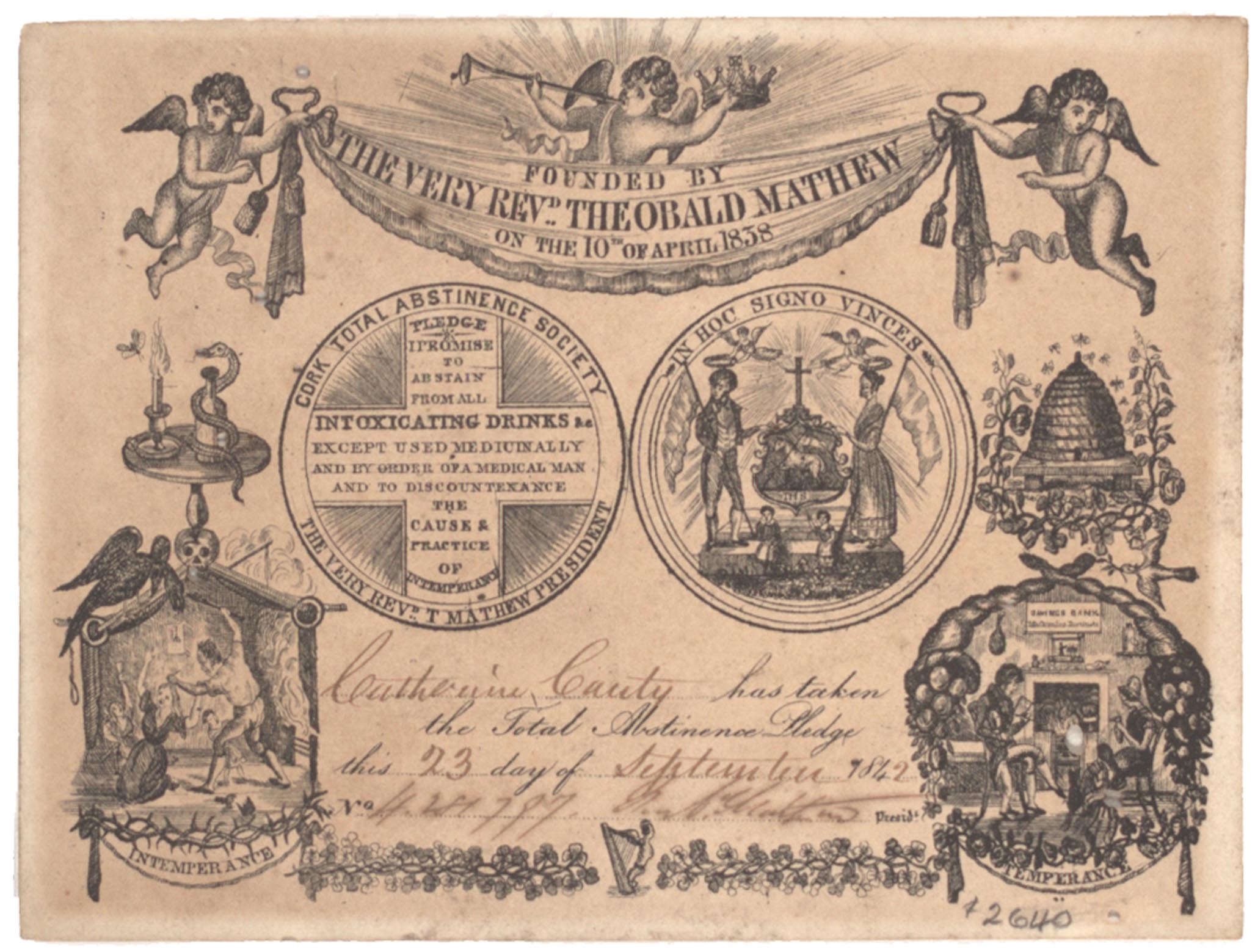
Abstinence Pledge Card by Matthew Theobald
"Theobald, Matthew. "Abstinence Pledge Card." 1842. Accessed January 12, 2015. http://www.gilderlehrman.org/sites/default/files/content-images/02542.27.jpg. "

     Above is an abstinence pledge card, a primary source, that supported the temperance movement that took place from the 1830s to late 19th century. The temperance movement influenced men to drink alcohol in moderation or pledge to total abstinence.
A Catholic priest in Dublin, Ireland, named Matthew Theobald, founded the Cork Total Abstinence Society in April 1838. Several men joined Theobald by signing in his abstinence book and promising to stay away from alcohol completely. Within three months of starting the society, more than 25,000 members had joined, and two months later the number jumped to 130,000. Theobald then traveled across Ireland and internationally, to Scotland and England in 1842, to convince more men to pledge abstinence and stop drinking. He also traveled to the United States in 1849 to spread awareness. By 1851, Theobald convinced as many as seven million people to pledge to total abstinence from alcohol.
In 1842, Father Matthew introduced this pledge card, signed by Theobald as president of the society. The pledge states: "I promise to abstain from all intoxicating drinks, except used medicinally and by order of a medical man, and to discountenance the cause and practice of intemperance." The card depicts a scene warning many the dangers of intemperance, such as domestic violence. Another image depicts a scene of temperance- the act leading to a happy family gathered, say, around the fireplace. This pledge card was signed by Catherine Cauty after four years of the society's founding, in September 1842, showing us that the society was still well-maintained after a long period of time.
This primary source shows us, and the members of the Abstinence Society, the benefits of staying away from drinking. The scenes depicted on the card, such as domestic violence due to intemperance, and a happy family due to abstinence, allow us to see the heavy impact drinking had on society. By analyzing the high number of members in the Abstinence Society, it is easy to see how many people had both personal and social conflicts that were caused by their bad drinking habits. However, Theobald traveled to world to teach the disadvantages of drinking and how the act of  self-control can lead to a life free of stress and conflict.